

As small and mid-sized businesses (SMBs) grow, technology becomes more complex and essential to daily operations. Internal IT teams are often responsible for managing everything from user support and cybersecurity to cloud platforms, infrastructure, and network performance. While these teams play a critical role in business success, increasing technology demands, limited resources, and evolving security threats can make it difficult to keep up.
That’s where co-managed IT support comes in. Co-managed IT is a collaborative approach that combines the knowledge of your internal IT staff with the expertise and resources of a managed service provider (MSP). Rather than replacing your existing team, the MSP works alongside them to provide additional support, proactive monitoring, cybersecurity services, and specialized technical expertise. This approach helps businesses strengthen their IT capabilities while allowing internal teams to focus on strategic initiatives and long-term technology goals.
At SolidBase IT, we help growing businesses build more efficient, secure, and scalable IT environments through flexible co-managed IT solutions. By extending the capabilities of internal IT teams, organizations can improve performance, reduce workload, and gain access to the resources needed to support continued growth.
In this guide, we’ll explore how co-managed IT works, how responsibilities are typically divided between internal teams and IT providers, and how SMBs can create a more scalable and effective technology strategy through a collaborative IT partnership.
What Is Co-Managed IT Support?
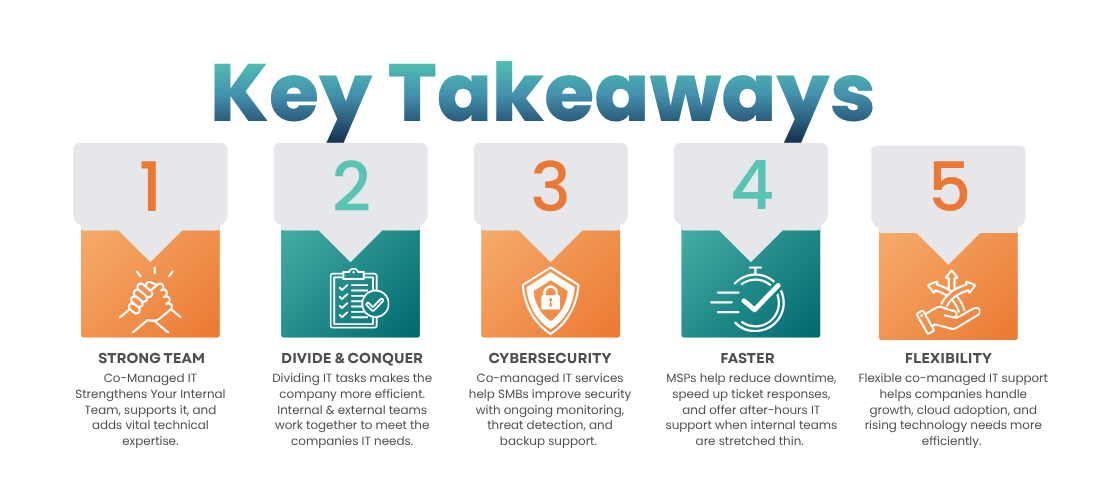
Co-managed IT support is a partnership between your internal IT team and a managed service provider (MSP). Rather than replacing in-house staff, both teams work together, sharing responsibilities based on business needs, available resources, and technical expertise.
Internal IT teams typically focus on day-to-day business operations, employee support, technology planning, and initiatives that directly support company goals. Meanwhile, the MSP provides additional resources, specialized expertise, proactive monitoring, cybersecurity support, and technical assistance to help fill gaps and extend the capabilities of the internal team.
This collaborative approach allows businesses to maintain control of their IT environment while gaining access to the tools, knowledge, and support needed to improve efficiency, strengthen security, and support future growth. By leveraging the strengths of both teams, organizations can create a more scalable and resilient IT strategy without overburdening internal staff.
How Co-Managed IT Support Works
In a co-managed IT model, your internal IT team and a managed service provider (MSP) work together to support the organization’s technology needs. Responsibilities are divided based on each team’s strengths, allowing businesses to improve efficiency, strengthen cybersecurity, and maintain reliable IT operations without overburdening internal staff.
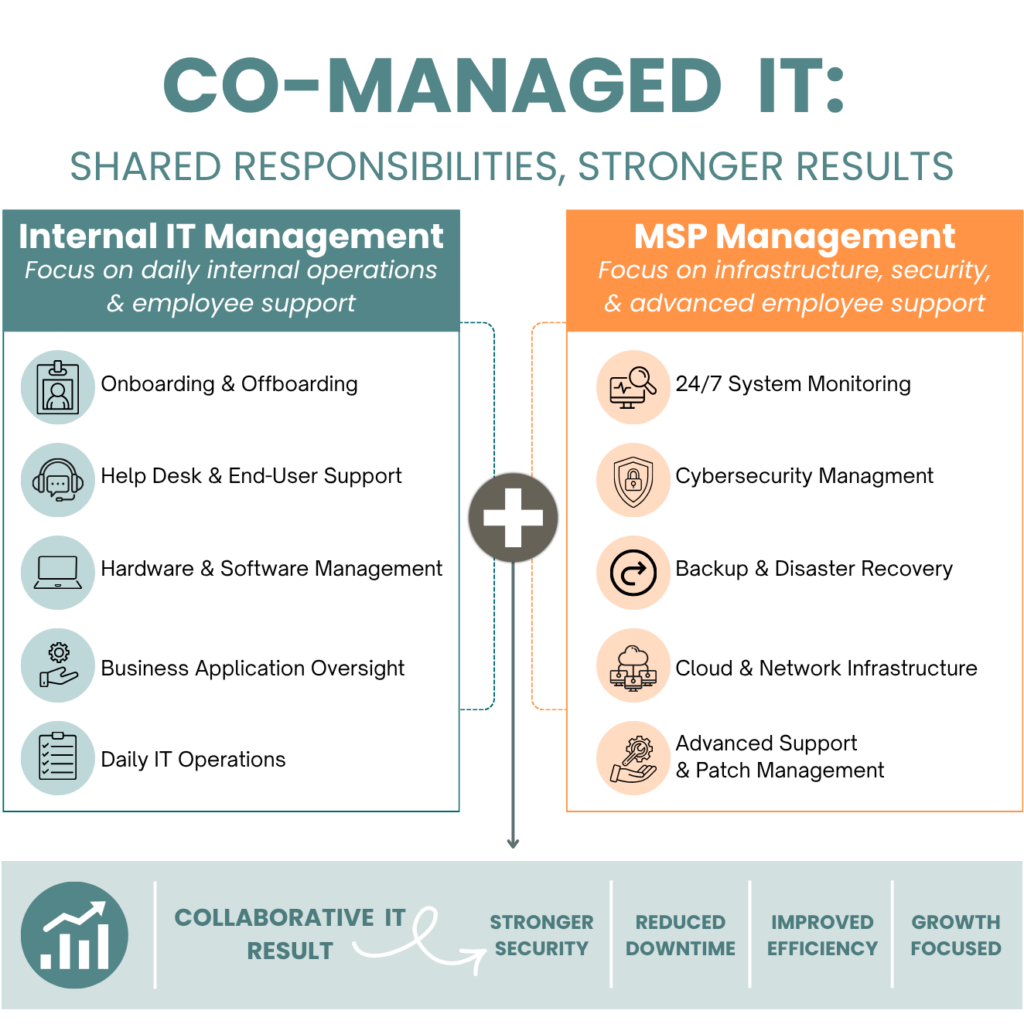
Typically, internal IT teams focus on supporting employees, managing business-specific systems, and overseeing day-to-day operations, while the MSP provides specialized expertise, proactive monitoring, infrastructure management, and advanced technical support.
What Does the Internal IT Team Manage?
Internal IT teams typically handle:
- Employee onboarding and offboarding
- Help desk and end-user support
- Device setup and software deployment
- Management of business-specific applications
- Day-to-day IT operations and technology planning
What Does a Managed Service Provider (MSP) Manage?
MSPs typically provide:
- 24/7 system monitoring and management
- Cybersecurity protection and threat detection
- Data backup and disaster recovery
- Cloud, network, and infrastructure management
- Patch management and advanced technical support
By sharing responsibilities, businesses gain the benefits of both internal knowledge and external expertise. This partnership helps reduce downtime, improve security, increase operational efficiency, and free internal IT teams to focus on strategic initiatives that support long-term business growth.
Benefits of Co-Managed IT for Small and Mid-Sized Businesses
Improved IT Coverage
Many small and mid-sized businesses (SMBs) operate with lean IT teams that are responsible for managing an increasingly complex technology environment. Co-managed IT support strengthens internal resources by providing access to additional expertise, tools, and personnel without the expense of building a larger in-house department. This allows businesses to resolve issues faster and maintain more consistent IT support.
Reduced Downtime and Faster Issue Resolution
Unexpected downtime can disrupt operations, impact productivity, and frustrate employees and customers alike. Co-managed IT services help minimize disruptions through proactive monitoring, preventative maintenance, and faster response times. By identifying and resolving issues before they escalate, businesses can keep critical systems running smoothly and avoid costly interruptions.
Stronger Cybersecurity Protection
Cybersecurity threats continue to grow in both frequency and sophistication. Co-managed IT support helps businesses strengthen their security posture by combining internal oversight with specialized cybersecurity expertise. Managed service providers (MSPs) can enhance protection through endpoint security, 24/7 threat monitoring, timely patch management, multi-factor authentication (MFA), and secure data backup solutions. Together, these measures help reduce risk, protect sensitive information, and improve overall business resilience.
Access to Specialized IT Expertise
Most SMBs cannot justify hiring full-time specialists for every area of technology. Co-managed IT provides access to experienced professionals in networking, cybersecurity, cloud computing, compliance, and infrastructure management. This specialized knowledge helps businesses make informed technology decisions and implement solutions that support long-term growth.
Scalable Support for Business Growth
As organizations grow, their technology needs evolve. New employees, additional locations, remote work environments, and cloud-based applications all place greater demands on IT resources. Co-managed IT services scale alongside the business, providing the flexibility and support needed to accommodate growth without sacrificing performance, security, or reliability.
Why Co-Managed IT Matters
Co-managed IT helps SMBs maximize the value of their internal IT team while gaining access to additional expertise and resources. By improving support coverage, strengthening cybersecurity, reducing downtime, and providing scalable technology solutions, businesses can focus less on IT challenges and more on driving growth and serving their customers.
When Should Small Businesses Consider Co-Managed IT Support?
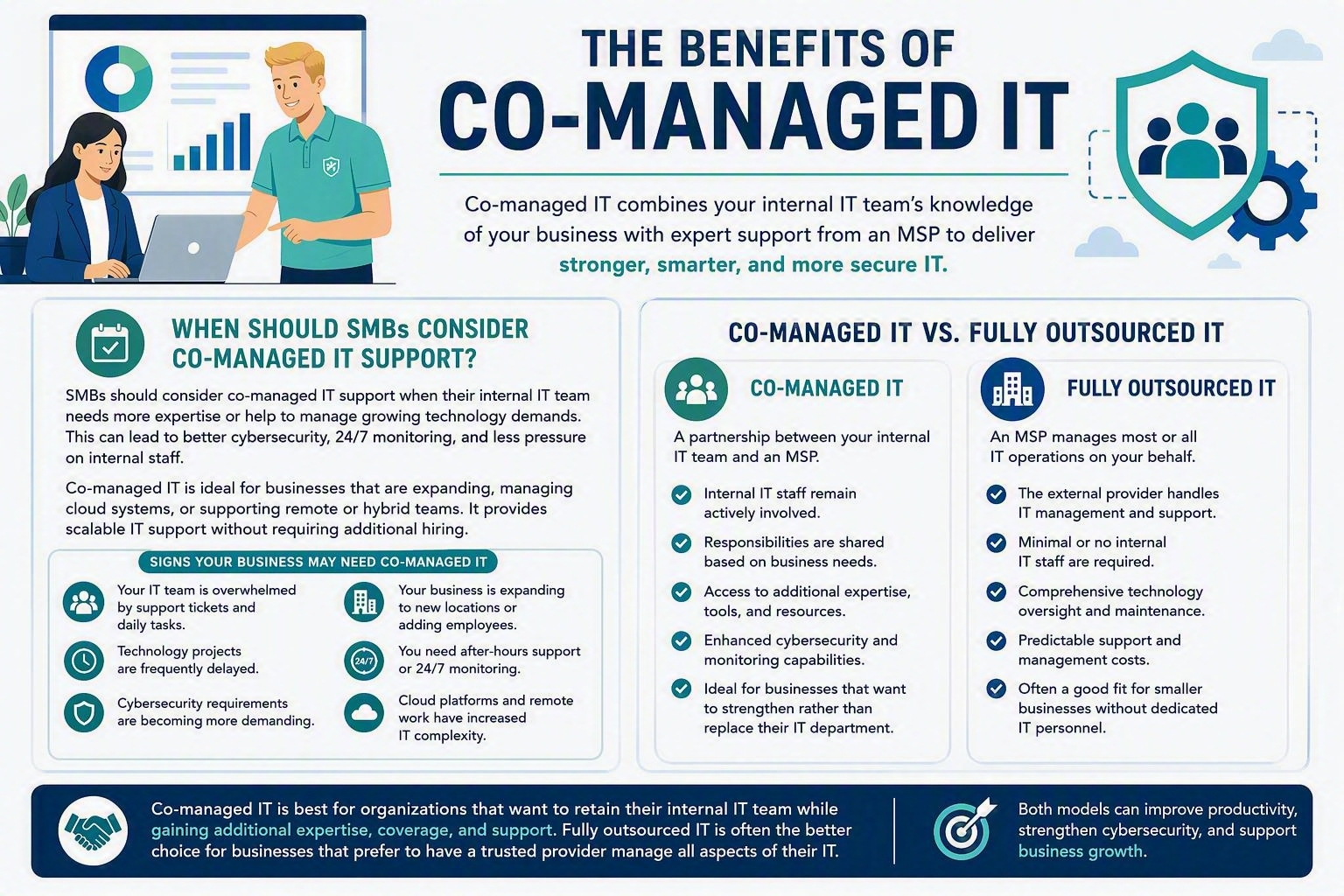
Small and mid-sized businesses should consider co-managed IT support when their internal IT team needs additional expertise, resources, or capacity to keep up with growing technology demands. By partnering with a managed service provider (MSP), businesses can strengthen cybersecurity, gain access to 24/7 monitoring, and reduce the workload placed on internal IT staff.
Co-managed IT is especially valuable for organizations experiencing rapid growth, adopting cloud technologies, or supporting remote and hybrid work environments. As technology becomes more complex, co-managed IT provides scalable support without the cost and challenges of hiring additional full-time IT personnel. This allows internal teams to focus on strategic initiatives while MSP experts help manage day-to-day operations, security, and infrastructure.
Signs Your Business May Need Co-Managed IT
- Your IT team is overwhelmed by support tickets and daily tasks.
- Technology projects are frequently delayed.
- Cybersecurity requirements are becoming more demanding.
- Your business is expanding to new locations or adding employees.
- You need after-hours support or 24/7 monitoring.
- Cloud platforms and remote work have increased IT complexity.
Co-Managed IT vs. Fully Outsourced IT
Businesses often compare co-managed IT and fully managed IT services when evaluating support options. The right choice depends on the level of internal IT involvement you want to maintain.
Co-Managed IT
Co-managed IT is a partnership between your internal IT team and an MSP.
Key Characteristics:
- Internal IT staff remain actively involved.
- Responsibilities are shared based on business needs.
- Access to additional expertise, tools, and resources.
- Enhanced cybersecurity and monitoring capabilities.
- Ideal for businesses that want to strengthen rather than replace their IT department.
Fully Outsourced IT
With fully outsourced IT, an MSP manages most or all technology operations on behalf of the business.
Key Characteristics:
- The external provider handles IT management and support.
- Minimal or no internal IT staff are required.
- Comprehensive technology oversight and maintenance.
- Predictable support and management costs.
- Often a good fit for smaller businesses without dedicated IT personnel.
Which Option Is Right for Your Business?
Co-managed IT is best for organizations that want to retain their internal IT team while gaining additional expertise, coverage, and support. Fully outsourced IT is often the better choice for businesses that prefer to have a trusted provider manage all aspects of their technology environment.
Both models can improve productivity, strengthen cybersecurity, and support business growth. The difference comes down to how much involvement you want your internal team to have in managing your technology.
Best Practices for Successful Co-Managed IT
A successful co-managed IT partnership depends on clear communication, defined responsibilities, and strong collaboration between your internal IT team and managed service provider (MSP). When both teams work together effectively, businesses gain faster support, stronger security, and more reliable technology performance.
To maximize the value of co-managed IT services, businesses should:
- Clearly define roles and responsibilities between internal IT staff and the MSP.
- Establish documented escalation procedures for resolving issues efficiently.
- Maintain regular communication and strategic planning meetings.
- Use shared documentation and knowledge management systems.
- Align cybersecurity policies, compliance requirements, and security protocols.
- Set measurable service goals and performance expectations.
When internal IT teams and MSPs operate as a unified technology partner, IT operations become more efficient and predictable. This collaborative approach helps reduce downtime, improve response times, strengthen cybersecurity, and ensure critical business systems remain available and secure.
Final Thoughts
Co-managed IT support helps small and mid-sized businesses (SMBs) maximize the value of their internal IT team while gaining access to the expertise, resources, and tools of a managed service provider. By combining internal business knowledge with specialized technical support, organizations can improve operational efficiency, strengthen cybersecurity, reduce downtime, and better support long-term growth.
For businesses with limited IT resources, growing technology demands, or increasingly complex cybersecurity requirements, co-managed IT offers a flexible and scalable solution. With clearly defined roles, open communication, and a shared commitment to business success, internal IT teams and MSPs can build a more secure, resilient, and future-ready technology environment.
Whether your organization needs additional cybersecurity expertise, help managing cloud environments, after-hours support, or extra resources to support growth, co-managed IT provides the flexibility to fill critical gaps without replacing your existing IT team. The result is stronger technology performance, better user experiences, and an IT strategy that can grow alongside your business.
Frequently Asked Questions
An internal IT team and a managed service provider (MSP) collaborate to provide co-managed IT support. To enhance cybersecurity, IT operations, and technical support, both teams share duties.
Co-managed IT keeps the internal IT team in control of day-to-day operations while an MSP provides additional expertise and specialized services. Fully outsourced IT places most or all IT responsibilities with the external provider.
SMB should consider co-managed IT when internal IT teams are managing increasing workloads, expanding infrastructure, stronger cybersecurity requirements, or restricted technical resources.
Advanced technical support, network and cloud management, backup and disaster recovery, cybersecurity management, patch management, and round-the-clock monitoring are all commonly provided by an MSP.
Yes, since co-managed IT enables companies to maintain consistent IT management and security while supporting cloud infrastructure, remote and hybrid work environments, and multiple offices.
Yes, co-managed IT allows SMB to access specialized IT expertise and enterprise-level support without the cost of hiring additional full-time IT staff, making it a scalable option for growing businesses.

- Red River: How Co-Managed IT Services Augment Your Internal Team
- TechnologySolutions.net: Co-Managed IT Explained: Is It the Right Fit for Your Internal IT Team?
- Synoptek: How Co-managed IT Services Strengthen Your IT Strategy
- Vertikal6: Co-Managed IT Services: A Smarter Way to Strengthen Your Internal IT Team
- Synoptek: Co-Managed IT Services vs. Fully Outsourced IT in 2026: Side-by-Side Comparison for Mid-Market CIOs
- Anders: A Business’s Guide to Co-Managed IT Services