

Choosing among today’s managed IT service providers involves more than comparing service lists. Most providers offer help desk support, cybersecurity, cloud management, network monitoring, and infrastructure maintenance. The key difference is how well those services align with your business goals, growth plans, and operational needs.
As a company grows, technology becomes more complex to manage. New employees, devices, applications, and user accounts increase the demands on IT. Expanding to multiple locations or supporting remote and hybrid work environments adds another layer of complexity that can strain existing resources.
While an internal IT professional or small team may effectively manage daily operations, larger initiatives, advanced cybersecurity requirements, cloud migrations, and strategic technology planning often require additional expertise. This is where partnering with a managed IT service provider can deliver significant value.
For organizations that already have internal IT staff, co-managed IT services offer a flexible alternative. In a co-managed model, the managed service provider works alongside your existing team, providing specialized expertise, additional support, and scalable resources without replacing internal personnel.
In this guide, we’ll explain what growing businesses should look for in a managed IT service provider, the key services that matter most, and how to identify a partner that can support both current needs and future growth.
What Is a Managed IT Service Provider?
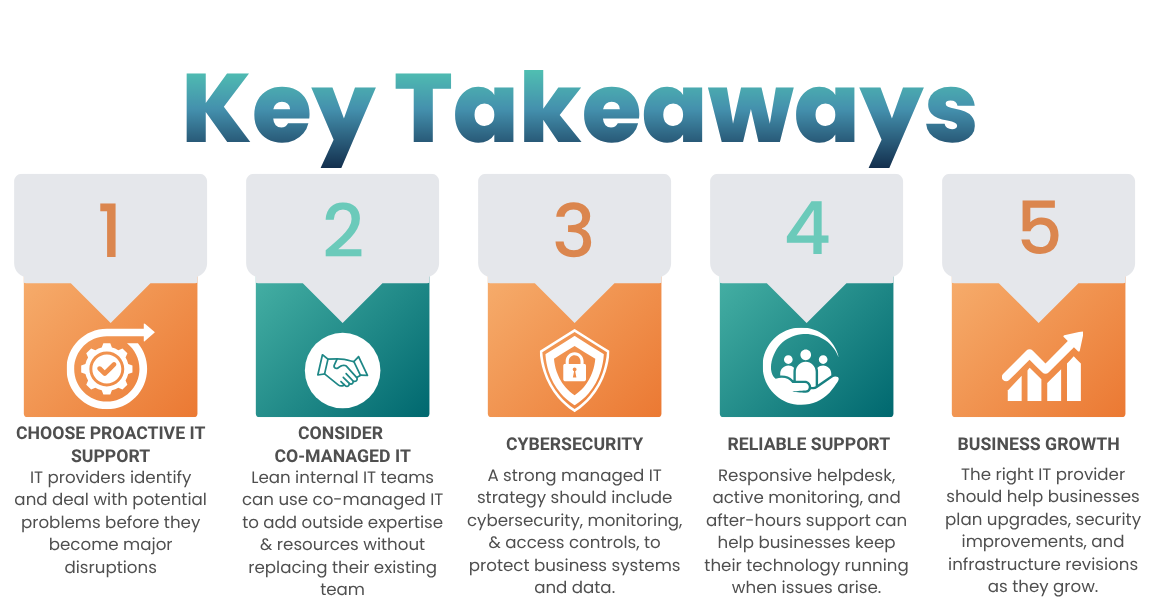
A managed IT service provider (MSP) is an external technology partner that manages, supports, and helps optimize some or all of a company’s IT environment. MSPs provide businesses with ongoing technical expertise, proactive monitoring, maintenance, cybersecurity, and strategic guidance without the expense of building a large internal IT department.
The exact services offered can vary depending on the provider and the needs of the organization, but managed IT services often include:
- IT help desk and technical support
- Active monitoring and alerting
- Endpoint management
- Network management
- Cybersecurity services
- Cloud management and support
- Software and security updates
- Data backup and disaster recovery
- IT project implementation
- Technology consulting
- Strategic IT planning
The primary difference between managed IT services and traditional break-fix support is the approach to technology management.
With break-fix support, IT assistance typically begins only after a problem occurs. Managed IT services take a proactive approach by continuously monitoring and maintaining systems to identify and address potential issues before they lead to downtime, security incidents, or business disruptions.
In addition to technical capabilities, the best managed IT service providers deliver strategic value. They offer proactive cybersecurity protection, tailored solutions that align with business goals, experienced and certified IT professionals, responsive support, and long-term technology planning that helps organizations scale more efficiently.
By serving as both a technology resource and strategic advisor, an MSP helps growing businesses improve reliability, strengthen security, and make more informed IT decisions as their needs evolve.
What Makes a Managed IT Service Provider One of the Best?
There is no single managed IT service provider that is the right fit for every business.
A small company with no internal IT staff may need fully managed support, while an organization with an experienced IT manager may only require assistance with cybersecurity, monitoring, major projects, or after-hours coverage. The best provider depends on the company’s goals, resources, and technology requirements.
That said, the strongest managed IT service providers tend to share several key characteristics.
1. Proactive IT Management
A quality managed IT provider does more than respond to problems after they occur. Effective IT management involves continuously monitoring and maintaining systems to identify issues before they disrupt business operations.
Proactive monitoring often includes:
- Computers and endpoints
- Networks
- Servers
- Cloud environments
- Backup systems
- Security tools
- Overall system performance
Providers should also manage routine maintenance tasks such as software updates, patch management, security controls, and performance optimization.
The goal is simple: detect and resolve issues early. For growing businesses, this often means less downtime, fewer disruptions, and a more reliable technology environment.
2. Strong Cybersecurity
Cybersecurity should be integrated into everyday IT operations rather than treated as a separate service.
Businesses rely on technology to manage customer information, financial data, communications, applications, and daily operations. A single cybersecurity incident can impact every part of the organization.
A managed IT service provider may help with:
- Endpoint security
- Network security
- Security monitoring
- Vulnerability management
- Identity and access controls
- Microsoft 365 security
- Backup and ransomware protection
- Security policy development
- Employee security awareness training
When evaluating providers, businesses should look beyond general cybersecurity claims. It’s important to understand exactly what security services are included, how threats are monitored, and what level of support is provided if an incident occurs.
3. Support That Fits the Business
The best providers recognize that every organization has different IT needs.
Some businesses prefer to outsource most or all of their technology management. Others want to maintain an internal IT team and use outside expertise to fill specific gaps. A provider should be flexible enough to support either approach.
Before selecting a managed IT partner, consider:
- How much IT responsibility should remain in-house?
- What areas does the current IT team manage effectively?
- Where are the biggest knowledge or resource gaps?
- Is after-hours or 24/7 support needed?
- Are major technology projects planned?
- Is cybersecurity becoming more difficult to manage internally?
- Will the company be adding employees, locations, or remote workers?
The answers can help determine whether a fully managed IT model or a co-managed IT partnership is the better fit.
4. Strategic IT Guidance
The best managed IT service providers act as more than technical support teams. They serve as strategic advisors who help businesses align technology decisions with operational and growth objectives.
This may include:
- Technology roadmap planning
- Budget forecasting
- Cloud strategy
- Infrastructure modernization
- Business continuity planning
- Compliance and risk management
- Technology recommendations for future growth
As businesses expand, strategic planning becomes just as important as day-to-day support. An experienced IT partner can help avoid costly mistakes and ensure technology investments support long-term business goals.
5. Responsive and Reliable Support
Even with proactive management, employees will occasionally need assistance. A provider’s responsiveness can have a direct impact on productivity and user satisfaction.
When evaluating support capabilities, consider:
- Response and resolution times
- Help desk availability
- Escalation procedures
- Communication practices
- Customer reviews and testimonials
- Dedicated account management
Fast, knowledgeable support helps employees stay productive and minimizes disruptions when issues arise.
6. Scalability for Growth
Technology needs rarely stay the same for long. The right managed IT provider should be able to scale services as the business grows.
Whether adding new employees, opening additional locations, adopting cloud solutions, or expanding security requirements, the provider should have the expertise and resources to adapt alongside the organization.
A long-term partnership is often more valuable than a short-term solution. Choosing a provider that can support future growth helps reduce the need to switch vendors as business requirements evolve.
What Is Co-Managed IT?
Co-managed IT is a partnership model where an external managed IT service provider works alongside an existing internal IT team. Instead of replacing internal IT staff, the provider supplies additional expertise, resources, and support in areas where extra assistance is needed.
This approach gives growing businesses access to specialized IT capabilities while allowing their internal team to maintain control over day-to-day operations and company-specific systems.
For example, an internal IT team may continue handling:
- Employee support
- User account management
- Onsite technical issues
- Business-specific applications
- Internal systems and processes
At the same time, a managed IT provider may support:
- Cybersecurity
- Network monitoring
- Patch management
- Cloud infrastructure
- Documentation
- IT projects
- Strategic technology planning
- Overflow support
- After-hours coverage
Co-managed IT is especially valuable for businesses that have capable internal IT personnel but need additional bandwidth, specialized expertise, or support for larger technology initiatives.
As organizations grow, internal IT teams are often expected to manage user support, infrastructure, security, software, vendors, cloud services, and strategic projects simultaneously. Even highly skilled teams can become stretched thin. Co-managed IT helps relieve that pressure by providing additional resources without requiring the company to hire multiple specialized professionals.
It can also provide access to expertise that may not justify a full-time position, such as cybersecurity specialists, cloud architects, compliance experts, or network engineers.
Managed IT vs. Co-Managed IT: Which Is Right for Your Business?
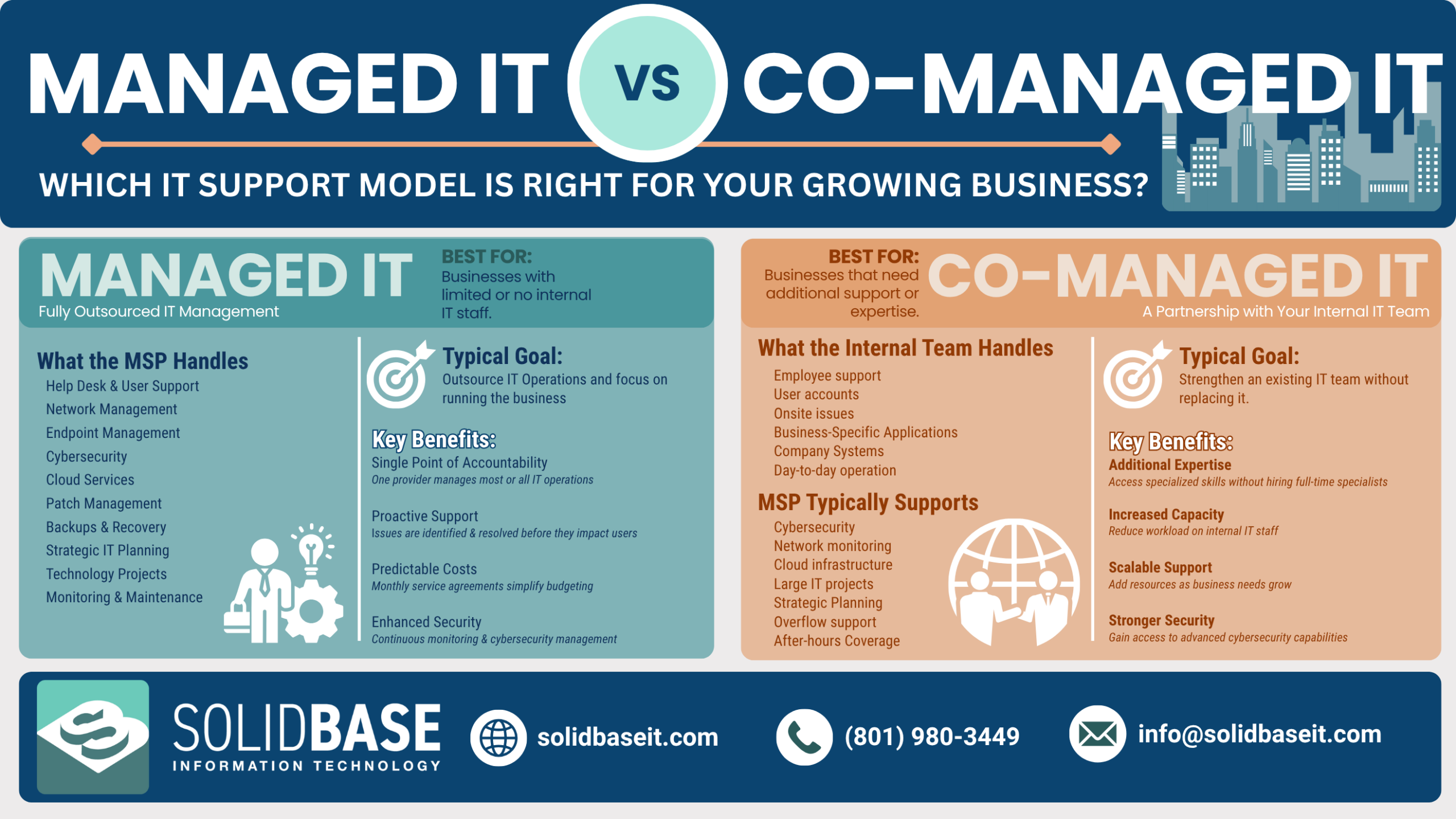
The primary difference between managed IT and co-managed IT is who takes responsibility for managing the IT environment.
With managed IT services, the provider assumes responsibility for managing most or all technology operations. This model is often ideal for businesses that do not have dedicated internal IT staff or prefer to outsource technology management entirely.
With co-managed IT services, the provider works alongside an existing IT team, supplying additional expertise, tools, and support where needed. This model is often a better fit for organizations that want to retain internal IT leadership while expanding their capabilities.
Managed IT Is Often Best For:
- Businesses with limited or no internal IT staff
- Organizations looking to outsource most IT responsibilities
- Companies seeking a single point of accountability for technology management
- Businesses that need comprehensive support, monitoring, and cybersecurity services
Co-Managed IT Is Often Best For:
- Businesses with existing IT personnel
- Internal teams that need additional capacity or specialized expertise
- Organizations managing complex projects or growth initiatives
- Companies that want stronger cybersecurity, monitoring, or after-hours support without expanding headcount
Neither approach is automatically better. The right choice depends on your organization’s goals, internal resources, growth plans, and technology requirements.
For many growing businesses, the decision comes down to a simple question: Do you need a provider to manage your IT environment, or do you need a partner to strengthen your existing IT team? The answer will help determine whether a fully managed or co-managed approach is the better long-term fit.
24/7 IT Support and Active Monitoring
Technology issues don’t always happen during business hours. A network outage, security alert, backup failure, or critical system problem can occur at any time. That’s why support coverage and active monitoring should be part of the evaluation process when choosing a managed IT service provider.
Before selecting a provider, ask:
- Is system monitoring available 24/7?
- Is emergency support available after hours?
- What issues qualify as emergencies?
- What are the response times for critical incidents?
- How are issues escalated?
- Is after-hours support included or billed separately?
Active monitoring is one of the biggest differences between managed IT and traditional break-fix support. Rather than waiting for users to report problems, managed IT providers continuously monitor systems to identify and address issues before they affect business operations.
This proactive approach can help detect:
- Performance problems
- Network issues
- Security threats
- Backup failures
- Device problems
- Infrastructure concerns
While no technology environment is completely immune to issues, active monitoring helps reduce downtime and minimize disruptions by identifying potential problems early.
How Managed IT Supports Business Growth
As businesses grow, technology requirements become more complex. New employees, multiple locations, cloud applications, remote workers, and evolving cybersecurity risks all place additional demands on IT resources.
A managed IT service provider can help businesses scale more efficiently by supporting:
Employee Growth
Provisioning devices, accounts, applications, permissions, and security controls for new hires.
Remote and Hybrid Work
Supporting secure cloud access, endpoint security, collaboration tools, and remote connectivity.
Multi-Location Operations
Planning and managing networks, security controls, and connectivity for additional offices or facilities.
Expanding Technology Environments
Maintaining network performance, security, and infrastructure as the number of users and devices increases.
The right IT partner helps ensure technology remains an enabler of growth rather than a barrier to it.
Strategic IT Planning: Looking Beyond Daily Support
The best managed IT service providers do more than solve technical problems. They help organizations plan for future growth and make informed technology decisions.
Questions that often benefit from strategic IT guidance include:
- Is aging hardware due for replacement?
- Can the current network support additional employees?
- Should certain applications move to the cloud?
- Are current cybersecurity controls sufficient?
- How should a new office be connected and secured?
- Which IT initiatives should be prioritized first?
- How much should be budgeted for future technology investments?
By combining day-to-day support with long-term planning, managed IT providers help businesses align technology decisions with operational goals, security requirements, and future growth plans.
Why Growing Businesses Choose SolidBase IT
Finding the right managed IT service provider is about more than comparing service lists. The best provider is one that aligns with your business goals, supports your growth plans, and delivers the right combination of technology expertise, cybersecurity, and responsive support.
For growing businesses, that often means finding a partner that can proactively manage technology while providing strategic guidance for the future. It also means having access to specialized expertise without necessarily expanding internal headcount.
SolidBase IT helps organizations address these challenges through a range of managed and co-managed IT services, including:
- Managed IT services
- Co-managed IT services
- Cybersecurity solutions
- Network management
- Cloud services and support
- IT projects and consulting
- Strategic IT planning
Unlike traditional break-fix support, SolidBase IT focuses on proactive technology management through continuous monitoring, endpoint management, threat protection, and ongoing maintenance designed to help prevent problems before they disrupt business operations.
For organizations with existing IT personnel, SolidBase IT’s co-managed IT model provides additional flexibility. Internal teams can continue managing day-to-day responsibilities while gaining access to advanced cybersecurity resources, monitoring, documentation, project support, cloud expertise, network management, and strategic guidance when needed.
This approach can be particularly valuable for growing businesses that have reached the point where a single IT administrator or small internal team is being asked to support increasingly complex technology environments.
Whether the challenge is managing a larger workforce, supporting remote employees, improving cybersecurity, planning infrastructure upgrades, or preparing for future expansion, SolidBase IT provides scalable support designed to help businesses operate more efficiently and grow with confidence.
Conclusion
The best managed IT service provider is not necessarily the one with the longest list of services. It is the one that best supports your business, your employees, and your long-term goals.
For organizations without dedicated IT staff, fully managed IT services can provide the expertise, support, and proactive management needed to maintain a reliable technology environment. For businesses with existing IT personnel, co-managed IT can add specialized expertise, additional capacity, and strategic support without replacing the internal team.
No matter which model is the better fit, the most effective IT partnerships share several key characteristics: proactive monitoring, strong cybersecurity, responsive support, scalability, and strategic planning.
As businesses grow, technology becomes increasingly important to productivity, security, customer experience, and long-term success. Choosing the right managed IT service provider helps ensure your technology remains an asset rather than an obstacle.
By evaluating providers carefully and selecting a partner that understands your organization’s unique needs, you can build an IT strategy that supports growth, reduces risk, and prepares your business for whatever comes next.
Frequently Asked Questions
A managed IT service provider is an outside company that manages and supports a business IT environment. Depending on the agreement, services may include technical support, monitoring, cybersecurity, network management, cloud services, endpoint management, backups, and IT strategy.
Managed IT services can provide businesses with access to ongoing technical support, active monitoring, cybersecurity expertise, and strategic-level IT guidance lacking requiring them to build all capabilities in-house.
Managed IT generally means the provider manages most or all of a business’s IT environment. Co-managed IT means the provider works alongside an existing internal IT team, providing additional capacity and expertise.
It can be. Co-managed IT is especially useful when a small internal IT team is responsible for too many tasks or lacks specialized expertise in areas such in terms of cybersecurity, cloud services, networking, or larger IT projects.
It can, depending on the business and service agreement, but it does not have to. Co-managed IT allows a company to retain its internal IT team while engaging an external provider for additional support.
Look for active monitoring, reliable cybersecurity, responsive support, open pricing, relevant technical expertise, flexible service options, and a provider who understands your business goals.
It depends on the provider and service package. Businesses should ask exactly which cybersecurity services are included rather than assuming all MSPs provide the same level of protection.
Active monitoring assists in identifying potential problems before they become major disruptions. It allows the provider to address system, network, performance, or security issues earlier.
Not every business does. However, companies that operate outside normal business hours or rely strongly on technology may benefit from after-hours support and uninterrupted monitoring.
Managed IT pricing varies based on the number of users, required services, technology environment, security needs, and the provider. Some providers use per-user pricing, while others use different pricing models. Solid Base IT currently lists fixed monthly per-user pricing for its managed IT service tiers.
A business may want to consider managed IT when its internal team is overwhelmed, technology problems are affecting productivity, cybersecurity needs are increasing, or the company needs more IT expertise than it can reasonably maintain internally.
Yes. Managed IT providers can support cloud applications, endpoint security, secure access, network connectivity, and technical support for remote employees. The exact services depend on the provider and agreement.
Yes. Many managed IT providers also offer project services. These can include network upgrades, cloud migrations, infrastructure revisions, cybersecurity improvements, and technology implementations.


- SolidBase IT: Managed IT Services
- SolidBase IT: Managed IT Services & Strategic IT Consulting in Utah
- SolidBase IT Cloud Solutions
- SolidBase IT: Network Manage Services
- SolidBase IT: Cybersecurity Services & Consulting
- SolidBase IT: Projects & Your Vision Executed to Your Satisfaction
- Signs Your Business Has Outgrown Internal IT Support