


A growing medical practice with five locations across Utah began as a small clinic and had expanded steadily, merging with existing clinics every 2–3 years. While it was expanding, its technology hadn’t kept pace. Staff were dealing with recurring IT issues, inconsistent support from multiple vendors, and cybersecurity concerns related to patient data. Every location seemed to have different systems, and routine problems were pulling employees away from patient care and causing significant worry for office staff.
The practice’s leadership faced a common challenge: they needed reliable technology management but weren’t ready to hire a full internal IT department. After evaluating their needs, they decided to partner with an outsourced IT provider that could centralize support, strengthen cybersecurity, and create a technology strategy aligned with their growth goals.
This scenario is increasingly common for small and mid-sized businesses. Whether you’re in healthcare IT, professional services, manufacturing, or retail, choosing the right outsourced IT provider can improve security, reduce downtime, and support long-term growth without the cost of expanding your internal team.
In this guide, we’ll explain the most common IT service models and the key factors to consider when comparing providers, helping you identify the best fit for your organization.
What Is an Outsourced IT Provider?
An outsourced IT provider is a technology partner that manages some or all of an organization’s IT operations. Businesses rely on outsourced IT providers to deliver expert technology support, strengthen cybersecurity, maintain critical systems, and align technology investments with business goals.
Depending on the agreement, an outsourced IT provider may be responsible for help desk support, infrastructure management, cloud services, device management, cybersecurity, system maintenance, compliance support, and strategic IT planning.
Outsourcing IT does not always mean replacing an internal IT team. Some organizations fully outsource their IT operations, while others use a co-managed approach that supplements in-house staff with specialized expertise and additional resources.
What Services Does an Outsourced IT Provider Offer?
The services offered vary by provider, but commonly include:
- Help desk and end-user support
- Network management and monitoring
- Endpoint and device management
- Cloud administration and support
- Microsoft 365 management
- Proactive system monitoring
- Patch management and software updates
- Data backup and disaster recovery
- Cybersecurity services
- Compliance and regulatory support
- IT consulting and strategy
- Technology planning and budgeting
When evaluating an outsourced IT provider, focus on your organization’s specific needs rather than selecting a provider solely based on the number of services offered. Ensure the services most important to your business are clearly included in the agreement.
How Do You Know When It’s Time to Outsource IT Services?
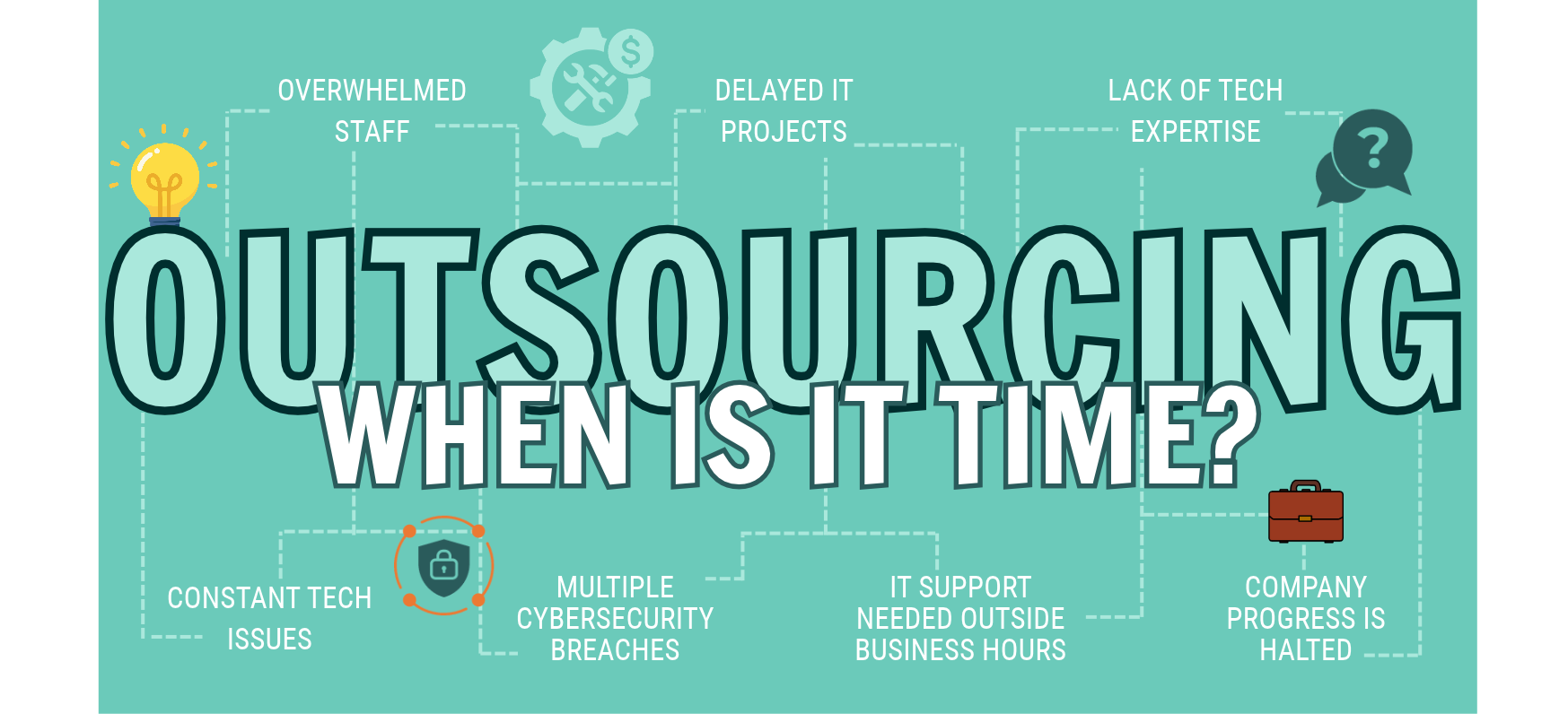
Many businesses reach a point where technology demands outgrow their internal resources. If your team is struggling to keep up, outsourcing can provide the expertise and support needed to maintain secure and reliable operations.
Common signs it’s time to consider outsourced IT services include:
- Support requests are overwhelming your IT staff.
- Critical IT projects continue to be delayed.
- Your organization lacks specialized technical expertise.
- Employees frequently experience technology issues.
- Cybersecurity and compliance requirements are becoming difficult to manage.
- Internal staff spend most of their time on routine maintenance instead of strategic initiatives.
- Business growth has introduced new locations, users, or systems.
- You need IT support outside normal business hours.
For organizations in Utah, particularly those operating in healthcare IT and other regulated industries, outsourcing can provide access to specialized expertise, stronger cybersecurity, and scalable support without the expense of hiring additional full-time staff.
The goal of outsourcing is not simply to offload work. The right IT partner, such as Solid Base IT, helps fill resource gaps, improve operational efficiency, reduce risk, and support long-term business growth.
What Should a Business Consider Before Hiring an Outsourced IT Provider?
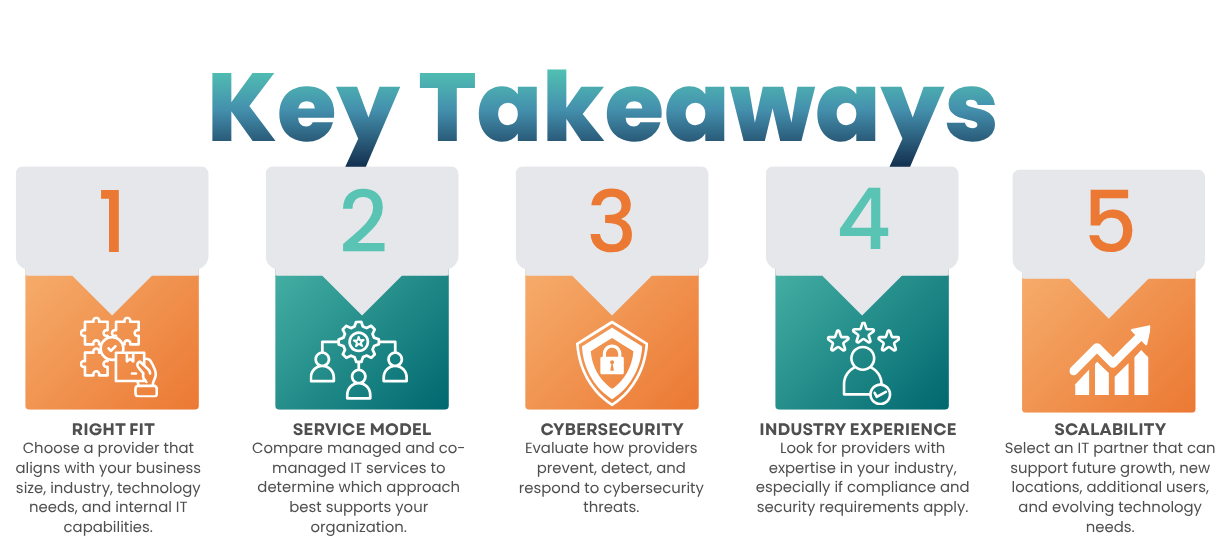
Choosing the right outsourced IT provider can improve security, reduce downtime, and support long-term growth. Before signing a contract, businesses should evaluate providers in several key areas.
Industry Experience and Expertise
Look for a provider with experience supporting organizations similar in size, complexity, and industry to your own. Industry knowledge is especially important for businesses that handle sensitive data or must comply with regulatory requirements.
For example, organizations in healthcare IT should seek providers familiar with HIPAA compliance, cybersecurity best practices, and the unique technology challenges facing medical practices and healthcare organizations.
Service Scope and What’s Included
Review the agreement carefully to understand exactly what services are covered.
Some providers include comprehensive support, while others charge additional fees for services such as:
- Cybersecurity solutions
- On-site support
- Cloud migrations
- Technology projects
- Compliance assistance
- Strategic IT consulting
Understanding what is included upfront helps prevent unexpected costs and ensures the provider can meet your business needs.
Response Times and Escalation Procedures
Reliable support is critical when technology issues impact business operations. Ask how support requests are prioritized, escalated, and resolved.
Key questions include:
- What are the support hours?
- Which communication channels are available?
- What are the guaranteed response times?
- How are critical emergencies handled?
- Who are the escalation contacts?
- Is on-site support available when needed?
A clear support process ensures issues are resolved quickly and efficiently.
Technology Coverage
Your IT provider should have expertise across the technologies your business relies on every day, including:
- Cloud platforms
- Networks and infrastructure
- Servers and endpoints
- Microsoft 365 environments
- Cybersecurity tools
- Line-of-business applications
- Backup and disaster recovery solutions
A provider that understands your technology ecosystem can deliver more effective support and planning.
Reporting and Communication
An effective IT partner should provide clear communication and regular reporting. Business leaders need visibility into system performance, security risks, support trends, and technology improvement opportunities.
Routine reports help organizations measure IT performance, understand ongoing risks, and make informed technology decisions.
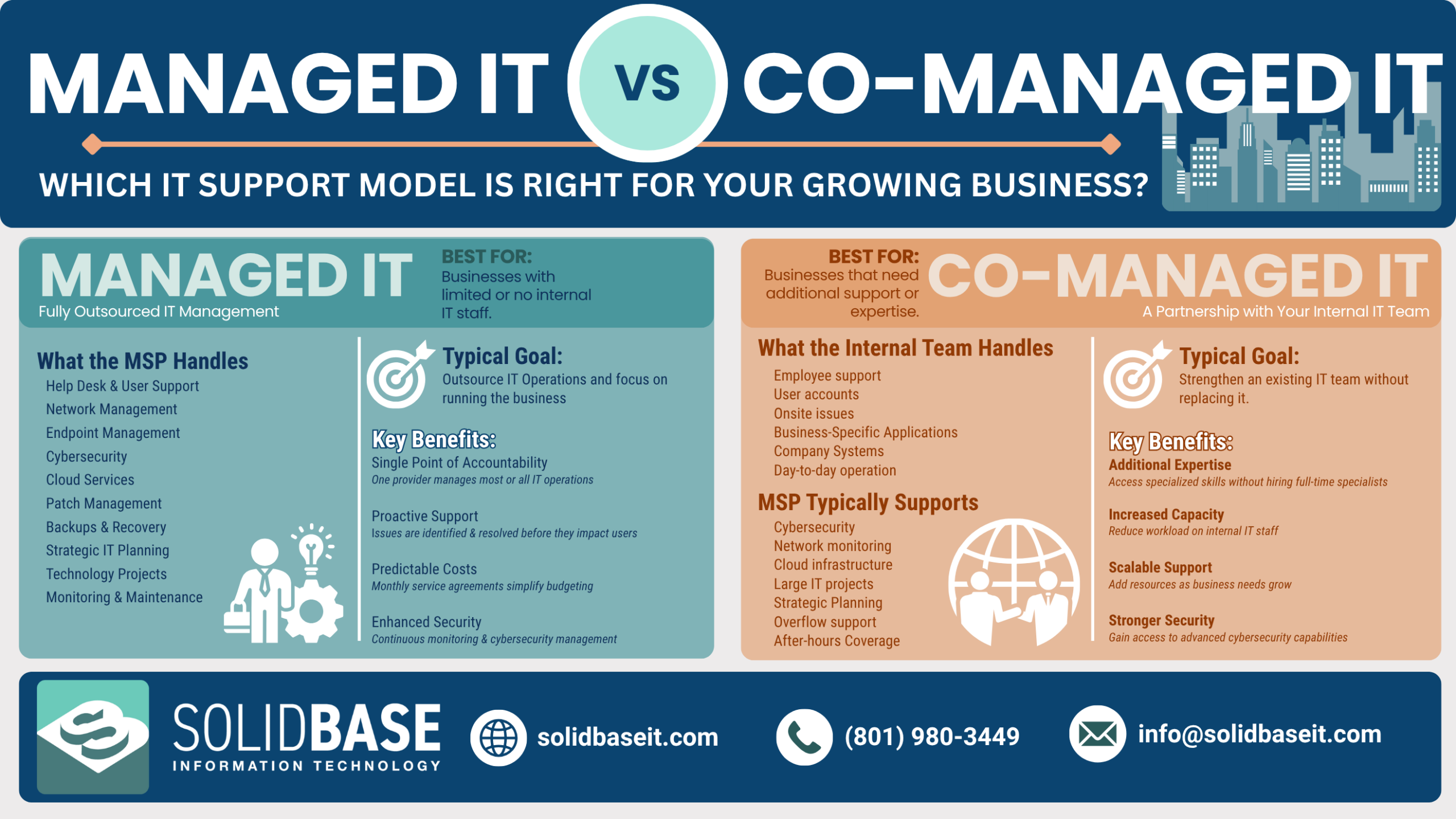
What Is the Difference Between Managed IT and Co-Managed IT?
The primary difference is how IT responsibilities are distributed between your organization and the service provider.
Managed IT Services
With managed IT services, an outsourced provider takes primary responsibility for maintaining and supporting your technology environment.
This model is often ideal for businesses that:
- Have limited internal IT resources
- Want predictable IT costs
- Need access to a broader range of technical expertise
- Prefer to focus on core business operations rather than technology management
The provider typically handles day-to-day support, cybersecurity, infrastructure management, monitoring, maintenance, and strategic IT planning.
Co-Managed IT Services
Co-managed IT combines the strengths of an internal IT team with the expertise of an external provider.
In this model, responsibilities are shared based on organizational needs. For example, internal staff may manage business applications and user relationships while the outsourced provider handles:
- Cybersecurity
- Infrastructure management
- Cloud services
- Specialized projects
- After-hours support
- Advanced technical expertise
This approach gives internal teams additional capacity and resources without replacing existing staff.
Which IT Model Is Right for Your Business?
Managed IT is typically the best fit for organizations that want a single provider to oversee most technology operations. Co-managed IT is ideal for businesses with internal IT staff that need additional expertise, tools, or support capacity.
The right choice depends on your organization’s size, growth plans, internal resources, and technology requirements. Many growing businesses in Utah choose either managed or co-managed services from providers such as Solid Base IT to improve cybersecurity, reduce operational risk, and support long-term growth.
When Is Co-Managed IT a Better Option?
Co-managed IT is often the best choice for organizations that already have internal IT staff but need additional expertise, resources, or support capacity. Rather than replacing an in-house team, a co-managed IT provider works alongside existing personnel to fill skill gaps and reduce workload.
Common situations where co-managed IT makes sense include:
- Large technology projects that require specialized expertise
- Advanced cybersecurity initiatives
- After-hours infrastructure monitoring and support
- Temporary staffing shortages or employee turnover
- Cloud migrations and modernization projects
- Compliance and regulatory readiness efforts
- Rapid business growth or expansion to new locations
This approach allows businesses to retain institutional knowledge while gaining access to external specialists, advanced tools, and additional support resources when needed.
Why Is Cybersecurity Important When Choosing an IT Provider?
Cybersecurity should be evaluated separately from general IT support. Managing technology systems and protecting them from cyber threats require different skill sets, processes, and tools.
A qualified IT provider should offer a proactive cybersecurity strategy that may include:
- Security assessments and risk analysis
- Endpoint detection and protection
- Vulnerability management
- Network monitoring and threat detection
- Identity and access management
- Incident response planning
- Security awareness training
- Backup and disaster recovery protection
When evaluating providers, ask how security services are delivered, what technologies are used, and how incidents are managed. The goal is to find a partner that actively improves your organization’s security posture rather than simply installing security software.
For organizations in healthcare IT, cybersecurity is especially important due to the sensitive nature of patient data and increasing regulatory requirements.
What Should Regulated Businesses Consider When Choosing an IT Provider?
Organizations operating in regulated industries should look for an IT provider with experience supporting applicable compliance frameworks and security requirements.
Key areas to evaluate include:
- Security assessments and risk management
- Access controls and identity management
- Data protection and encryption
- Compliance documentation and reporting
- Security monitoring and logging
- Policy development and governance
- Audit preparation and support
- Ongoing compliance reviews
For example, healthcare organizations should work with providers familiar with HIPAA requirements and the technology controls needed to protect sensitive patient information.
It’s also important to understand which compliance responsibilities belong to the provider and which remain the responsibility of your organization. A provider can support compliance efforts, but accountability typically remains with the business.
Compliance should not be treated as a one-time project. As technology, employees, regulations, and business processes evolve, security controls and compliance programs must adapt as well.
Businesses across Utah increasingly seek IT partners that can support both operational technology needs and compliance requirements. Providers such as Solid Base IT help organizations strengthen security, reduce risk, and maintain compliance while supporting long-term business growth.
Why Is Scalability Important When Choosing an Outsourced IT Provider?
Scalability is one of the most important factors to consider when selecting an outsourced IT provider. As your business grows, your technology needs will evolve, and your IT partner should be able to support that growth without disrupting operations.
A growing organization may need to:
- Add new employees and devices
- Open additional locations
- Expand cloud services and workloads
- Implement new business applications
- Strengthen cybersecurity measures
- Meet new compliance requirements
The right provider should have the resources, processes, and expertise to support these changes efficiently. Before signing an agreement, ask how service levels, onboarding procedures, pricing, and support capabilities will adapt as your organization grows.
For expanding businesses in Utah, choosing a scalable IT partner helps ensure technology remains an enabler of growth rather than a barrier to it.
How Should a Business Compare IT Providers?
Comparing IT providers becomes easier when you follow a structured evaluation process.
Step 1: Assess Your Current IT Challenges
Identify existing pain points, including:
- Recurring technology issues
- Security concerns
- Staffing limitations
- Delayed IT projects
- Compliance challenges
Understanding your needs will help you identify the right type of provider.
Step 2: Define Required Services
Separate essential services from those that may be beneficial but are not immediately necessary.
Examples may include:
- Help desk support
- Cybersecurity services
- Cloud management
- Compliance assistance
- Strategic IT consulting
Step 3: Evaluate Industry Experience
Look for providers with experience supporting organizations of a similar size, industry, and technical complexity.
This is especially important for healthcare IT organizations and other businesses operating in regulated environments.
Step 4: Compare Service Agreements
Review each agreement carefully and compare:
- Included and excluded services
- Response and resolution targets
- Support hours
- Project costs
- Contract terms
A clear agreement reduces the risk of unexpected fees and service gaps.
Step 5: Assess Cybersecurity Capabilities
Cybersecurity should be a major consideration when selecting an IT partner.
Ask how the provider:
- Monitors for threats
- Protects business data
- Responds to security incidents
- Conducts vulnerability management
- Supports regulatory compliance
Step 6: Evaluate Collaboration and Communication
If you have internal IT staff, determine how well the provider can integrate with existing workflows and responsibilities.
The strongest IT partnerships are built on clear communication, transparency, and collaboration.
Step 7: Consider Future Growth
Choose a provider that can support your long-term business objectives. Evaluate whether they can scale services as your organization expands, adopts new technologies, or enters new markets.
Can Solid Base IT Support Businesses with Internal IT Teams?
Yes. Solid Base IT offers co-managed IT services designed to complement and strengthen existing internal IT departments rather than replace them.
With a co-managed approach, responsibilities are shared between your internal team and Solid Base IT based on your organization’s needs.
This model can provide additional expertise and capacity in areas such as:
- Infrastructure management
- Cybersecurity and risk management
- Network and system monitoring
- IT documentation and process improvement
- Technology projects and migrations
- Strategic IT planning
- Compliance support
This approach allows internal IT staff to remain focused on business-specific initiatives while leveraging external specialists for complex projects, advanced security requirements, and routine operational tasks.
For organizations that prefer to outsource most or all of their IT operations, Solid Base IT also provides comprehensive managed IT services, including:
- Proactive monitoring and maintenance
- Help desk and end-user support
- Endpoint and device management
- Microsoft 365 administration
- Cybersecurity services
- Backup and disaster recovery solutions
Businesses with advanced security requirements can also benefit from specialized cybersecurity services, including:
- Security risk assessments
- Network security monitoring
- Incident response planning
- Penetration testing
- Information security gap assessments
Why Businesses Are Choosing Outsourced IT Support in 2026
Business technology today extends far beyond maintaining computers and networks. Organizations rely on cloud applications, remote work platforms, cybersecurity tools, connected devices, and collaboration software to keep operations running smoothly. As these environments become more complex, managing everything in-house often requires specialized expertise, continuous monitoring, and significant investment.
That’s why many small and mid-sized businesses are turning to outsourced IT support in 2026. Partnering with a managed services provider (MSP) gives organizations access to experienced IT professionals, proactive maintenance, and enterprise-grade technology resources without the expense of building a large internal IT department.
Key benefits of outsourced IT support include:
- Lower and more predictable IT operating costs
- Access to experienced IT specialists and technical expertise
- 24/7 monitoring and responsive technical support
- Stronger cybersecurity protection and risk management
- Faster issue resolution and reduced downtime
- Improved business continuity and disaster recovery readiness
- Scalable IT services that grow alongside the business
For many organizations, outsourced IT support is more than a cost-saving measure. It is a strategic investment that helps improve operational efficiency, strengthen security, and ensure employees have the technology support they need to stay productive. Providers often help businesses balance daily IT demands with longer-term technology planning, allowing internal teams to focus on initiatives that drive growth and innovation.
Why Is Solid Base IT a Good Fit for Growing Businesses?
Growing organizations often face increasing technology demands, heightened cybersecurity risks, and limited internal resources. Solid Base IT helps address these challenges by providing flexible service options that scale with business needs.
Whether an organization needs fully managed IT services, co-managed IT support, cybersecurity expertise, or compliance assistance, Solid Base IT offers solutions that adapt to existing operational structures rather than forcing businesses into a one-size-fits-all model.
This flexibility is particularly valuable for:
- Small and mid-sized businesses experiencing rapid growth
- Multi-location organizations
- Businesses expanding their cloud infrastructure
- Companies with limited IT staff
- Organizations in regulated industries such as healthcare IT
By offering both managed and co-managed service models, Solid Base IT enables businesses to choose the level of support that best aligns with their goals, internal capabilities, and growth plans.
Final Thoughts
Think back to the growing Utah medical practice from the beginning of this guide. As the organization expanded to multiple locations, technology became increasingly difficult to manage internally. Security requirements grew, support requests multiplied, and maintaining reliable systems across every office became more complex.
This is a challenge many small and mid-sized businesses face as they grow.
Choosing the right outsourced IT provider starts with understanding your organization’s specific technology needs rather than simply comparing service lists. Businesses with limited internal IT resources may benefit from fully managed IT services, while organizations with existing IT staff often find greater value in a co-managed partnership that adds expertise and capacity where it’s needed most.
Security, compliance, scalability, communication, and industry experience should all play a role in the decision-making process. This is especially true for organizations in healthcare IT and other regulated industries where cybersecurity and compliance are critical to operations.
For businesses across Utah, Solid Base IT provides both managed and co-managed IT services, along with cybersecurity and compliance-focused solutions. This allows organizations to choose the right level of support while maintaining control over the areas that matter most to them.
Ultimately, the best IT provider is not necessarily the largest or the least expensive. It’s the partner that understands your business, communicates clearly, strengthens your technology environment, and can scale alongside your organization as it grows.
Frequently Asked Questions
The cost of outsourced IT services varies based on several factors, including the size of your organization, the complexity of your technology environment, security requirements, and the level of support needed.
Common pricing models include:
- Per-user pricing
- Per-device pricing
- Monthly managed service plans
- Fixed-fee project engagements
- Customized service agreements
When comparing costs, look beyond the monthly fee. Evaluate what services are included, the level of support provided, cybersecurity offerings, response times, and the overall value delivered.
The lowest-priced option is not always the best value. Some providers charge extra for services that others include as part of a comprehensive managed IT package.
There is no one-size-fits-all approach. Internal IT teams offer valuable business knowledge and direct oversight, while outsourced IT providers bring specialized expertise, additional resources, and broader technical capabilities.
For many organizations, the most effective solution is co-managed IT, which combines the strengths of an internal team with the support of an external IT partner. This approach allows businesses to maintain control while gaining access to specialized skills and scalable support.
Yes. Many small and mid-sized businesses choose to outsource specific technology functions while keeping other responsibilities in-house.
Commonly outsourced services include:
- Cybersecurity management
- Cloud administration
- Network monitoring
- Help desk support
- Backup and disaster recovery
- Compliance support
This flexible approach allows businesses to address skill gaps and reduce workload without fully outsourcing their IT environment.
An MSP (Managed Service Provider) is a company that delivers ongoing IT management and support through a structured service agreement.
Managed Service Providers typically offer:
- Proactive monitoring and maintenance
- Technical support and help desk services
- Infrastructure management
- Cybersecurity services
- Cloud administration
- Strategic IT planning
The goal of an MSP is to keep technology running efficiently while reducing downtime, improving security, and supporting business growth.
A well-defined IT services agreement should clearly outline:
- Included services
- Support hours and availability
- Response and resolution targets
- Pricing structure
- Roles and responsibilities
- Escalation procedures
- Cybersecurity responsibilities
- Services not covered by the agreement
- Project management and billing processes
Reviewing these details upfront helps avoid misunderstandings and unexpected costs.
No. Outsourcing does not necessarily replace internal IT personnel.
Many organizations use co-managed IT services to supplement their existing team with additional expertise, cybersecurity resources, project assistance, or after-hours support. This model allows businesses to retain internal knowledge while gaining access to specialized technical capabilities.
Cost is important, but it should not be the primary decision-making factor. The least expensive provider may not offer the services, expertise, or security capabilities your business requires.
When comparing providers, evaluate:
- Service offerings
- Response times
- Cybersecurity capabilities
- Industry experience
- Compliance expertise
- Scalability
- Reporting and communication practices
- Long-term business value
A provider that delivers stronger security, faster support, and better strategic guidance often provides significantly greater value than a lower-cost alternative.

- How to Choose the Best IT Support Company
- Managed IT Providers for SMBs: What Growing Businesses Should Look For
- Best Managed IT Service Providers for Growing Businesses: Choosing the Right Partner
- List ItemCo-Managed IT Support: Small and Mid-sized Business (SMB) Teaming Guide
- 7 Signs Your Business Has Outgrown Internal IT Support
- In-House IT vs. Outsourcing: Which Is Better for Small Businesses?
- 7 Questions to Ask IT Support Providers in Utah